

6 November 2026
Disease Mitigation and Chlorophyll Stimulation in Tea Plants (Camellia sinensis) Through Agrohomoeopathic Treatment: A Case Study from the Nilgiris Hill
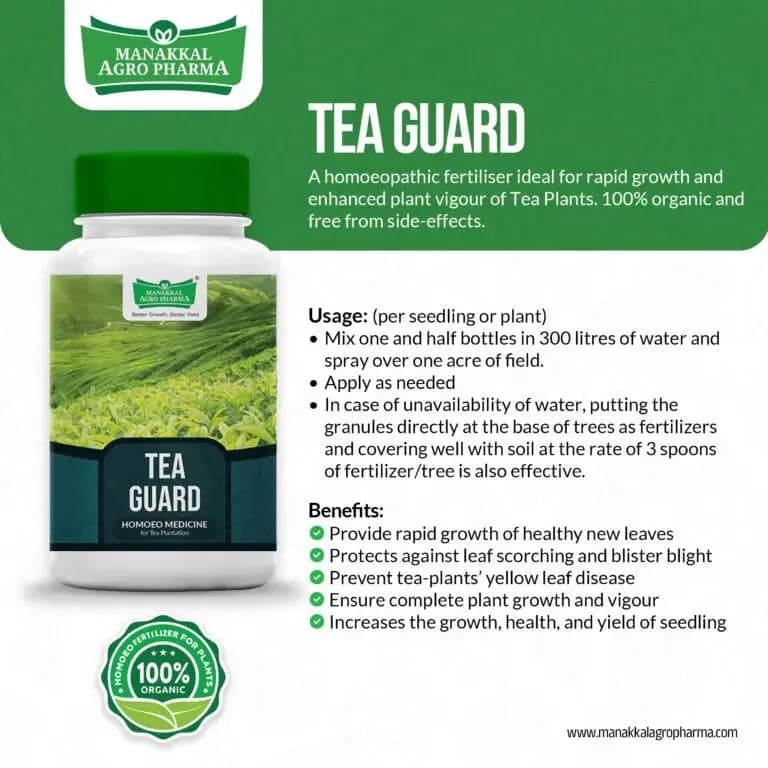
Tea Guard strengthens disease resistance, restores plant vitality, and enhances leaf quality and yield.
Tea cultivation in the Nilgiris hills and adjacent regions faces recurrent disease pressure, seasonal stress and fluctuating yields. Traditional chemical-intensive management often yields inconsistent results and raises environmental and health concerns. This case report describes a longitudinal farmer-led trial of the agrohomoeopathic formulation Tea Guard on a well-established plantation managed by farmer Krishnamurthy (Uppatti, Nilgiris), who has over fifty years in farming and more than three decades in tealeaf cultivation. Prior to treatment, the plantation suffered from a localised disease referred to by growers as “red bite” during summer—characterised by reddening of leaves or stems—and a monsoon/winter stem-rot condition known as stem borer. Average yield stood at 600 kg of plucked leaves per harvesting cycle. Upon applying Tea Guard, with an application frequency of once every two months, a controlled trial was conducted: one portion of the plantation left untreated as control, while the rest received Tea Guard. After a single treatment cycle, the treated block exhibited deeper leaf greenness (indicative of higher chlorophyll content), renewed vegetative vigour and elevated yield of 950 kg, suggesting a substantial recovery potentially linked to physiological revitalisation. This case underscores the potential role of agrohomoeopathic inputs as complementary tools in sustainable tea cultivation, warranting further empirical research and systematic trials.
Introduction
Tea remains an important cash crop in India’s high-range plantations, contributing significantly to rural livelihoods and regional economies. However, tea growers frequently face recurring disease challenges—particularly under stress conditions such as dry summer or excessive moisture in monsoon and winter seasons. In the Nilgiris region, smallholders have reported recurrent leaf reddening under summer stress and periodic stem rot in wetter months. Conventional remedies, including chemical fertilisers and fungicides, often yield limited and inconsistent gains, while raising concerns about soil fertility decline, chemical residues and labour intensity.
In this context, agrohomoeopathy has emerged as a potential alternative or complementary approach to conventional agrochemicals. By using highly diluted bio-stimulatory formulations, agrohomoeopathy aims to activate plant physiological mechanisms, strengthen innate defence responses and restore metabolic balance — rather than relying solely on chemical suppression of pathogens. The formulation Tea Guard has been introduced to some growers as a holistic tea-plant tonic intended to support plant vigour, immunity and yield under local environmental pressures.
This case study presents field-level evidence from a decades-old plantation managed by Krishnamurthy in Uppatti (Nilgiris), comparing untreated and Tea Guard-treated blocks under the same environmental conditions. The observed response in yield, leaf condition and disease resistance offers preliminary but compelling insight into the practical benefits of agrohomoeopathic intervention in tea cultivation.
Table-1 Major Diseases of Tea (Camellia sinensis) in Kerala Plantations
Disease | Parts affected | Causal Agent | Typical Outcome / Result |
Blister Blight | Young leaves, tender shoots, buds | Exobasidium vexans | Blister-like lesions, reduced photosynthetic area, distorted shoot growth, severe drop in green-leaf yield. |
Grey Blight | Mature leaves | Pestalotiopsis theae | Brown–grey leaf spots, premature leaf fall, weakened bushes, reduced flush formation. |
Red Rust | Leaves and young stems | Cephaleuros virescens (parasitic alga) | Reddish-brown patches, impaired photosynthesis, weakened stems, secondary infections. |
Black Rot | Leaves and young stems | Corticium invisum | Black necrotic tissues, shoot collapse, major loss of pluckable leaves during monsoon. |
Root Rot / Collar Rot | Roots and collar region | Armillaria, Fomes, Poria spp. | Yellowing, leaf drop, stunted growth, progressive weakening, often plant death. |
Stem Canker | Stems and branches | Macrophoma theicola | Dark sunken lesions, girdling of stems, restricted sap flow, dieback of shoots. |
Twig Dieback / Branch Blight | Upper branches and stems | Colletotrichum spp., Phomopsis spp. | Progressive drying of twigs, reduced canopy density, lower plucking surface. |
Red Leaf / Red Scorch (physiological disorder) | Leaves (especially during summer) | Heat stress, nutrient imbalance, incidental fungal stress | Reddening, leaf scorch, reduced chlorophyll, weak flush, delayed recovery. |
Stem borer/rot complex | Stems (mostly during monsoon/winter) | Insect borers and associated fungi | Boring tunnels, stem weakening, rot, reduced sap flow and leaf production. |
Case and Methods
The plantation spans several acres and has been under continuous cultivation for over 35 years. Standard practice involves harvesting mature leaves monthly or bimonthly depending on plant health. In this plantation, under normal chemical-based care, harvest yield from a single cycle was approximately 600 kg per cycle.
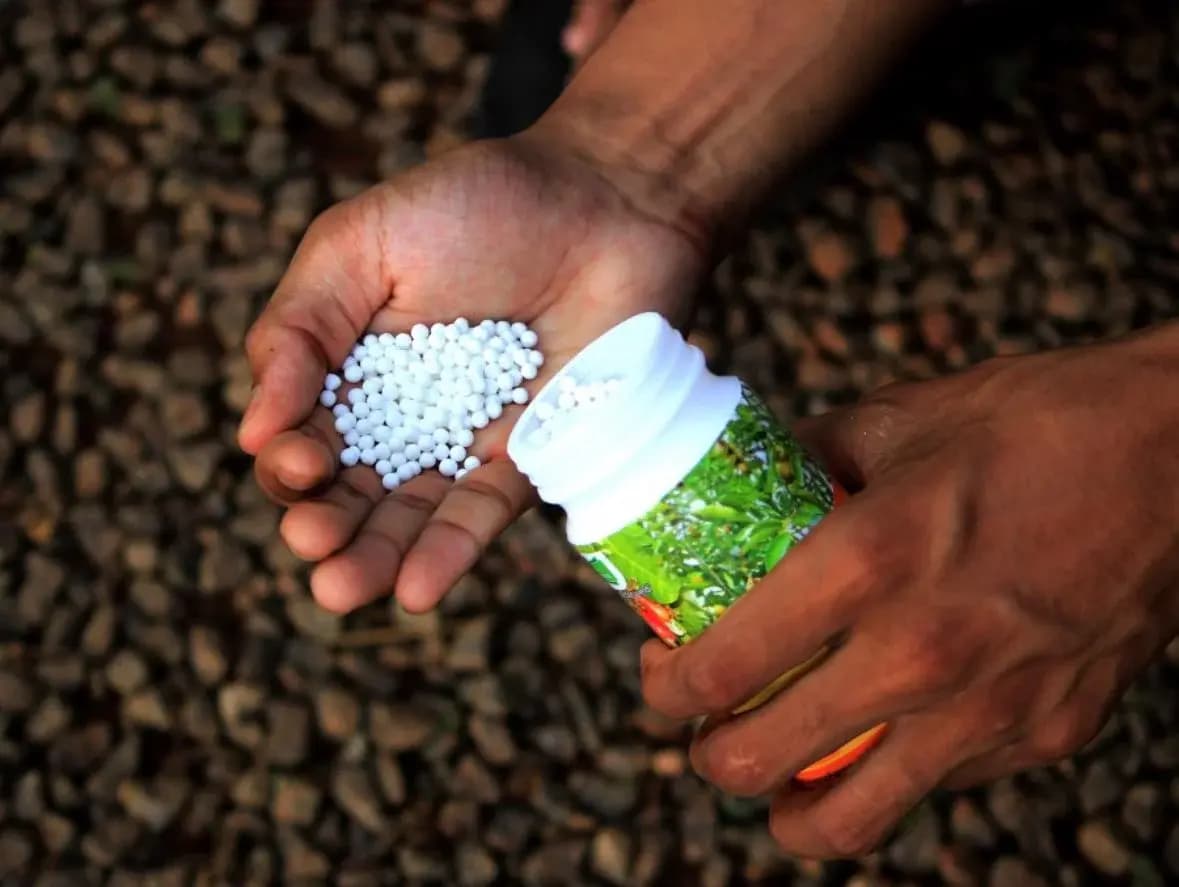
Facing persistent stress-induced problems — seasonal red bite disease in summer and stem rot during monsoon and winter — the farmer elected to adopt Tea Guard on a trial basis. The treatment protocol involved applying the remedy to one designated block through basal soil drenching at the start of the dry season, then again after two months. An adjacent block was left untreated to serve as control. No other fertiliser or chemical treatments were altered during the period. Growth conditions, rainfall, shade and plantation management remained consistent across both blocks.
Observations were recorded through direct inspection, foliar colour assessment (chlorophyll-rich greenness), yield measurement at harvest, and health monitoring — including incidence of stem rot, leaf reddening, wilting or defoliation.
Observations and Results
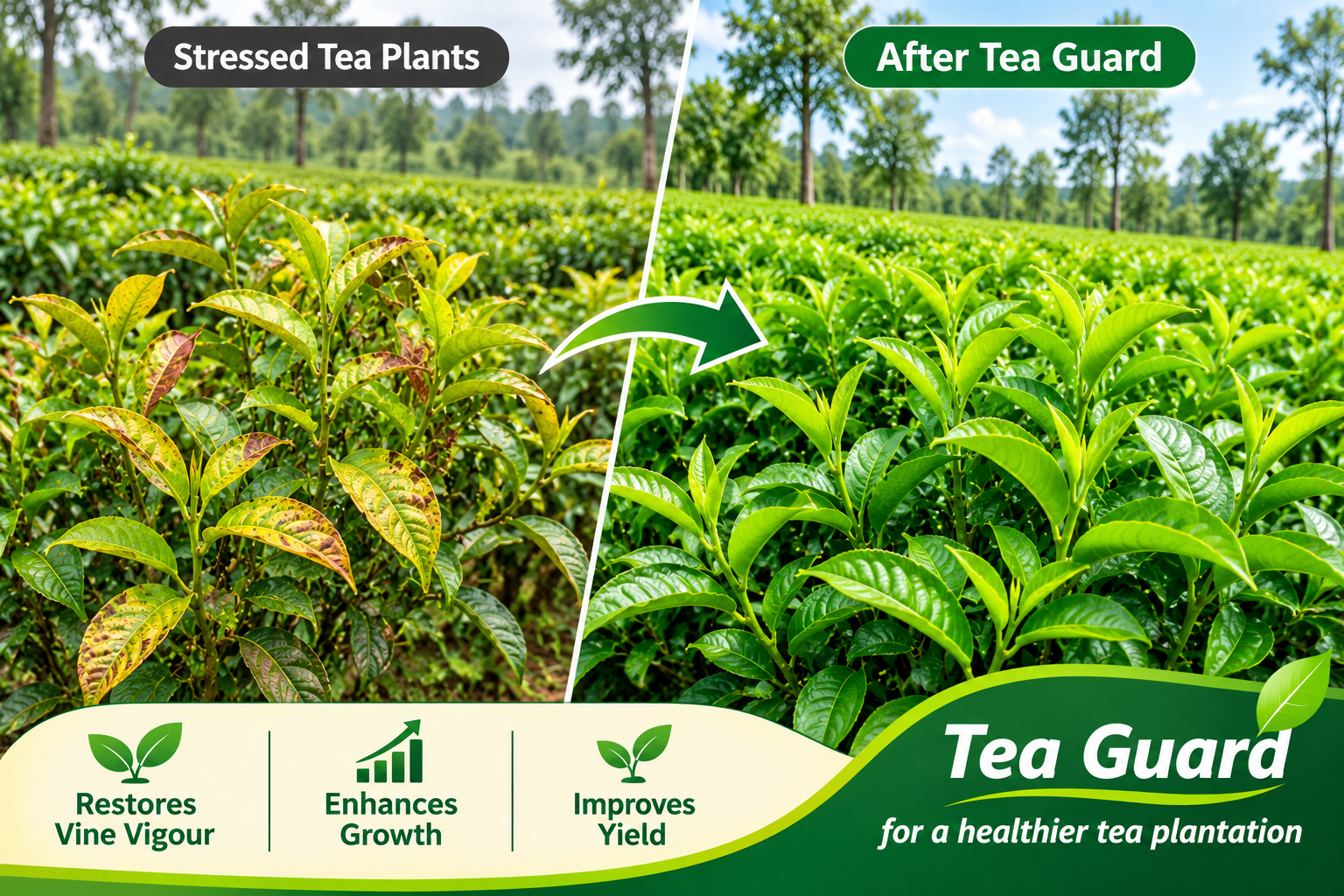
Within fifteen days of the initial application of Tea Guard, the treated block exhibited a distinct and uniform deep-green foliage across nearly all tea bushes, in contrast to the comparatively dull, yellow-green hue of control plants. No further reddening or wilting was observed during the subsequent dry period, and the usual red bite symptoms did not reappear.
At the time of the next harvest, the first full cycle post-treatment the yield from the treated block reached 950 kg, representing more than a 50 per cent increase compared with the historical average of 600 kg. The increase occurred without application of additional fertilisers or fungicides.
One harvesting cycle later, the treated block maintained higher vigour, healthier leaf appearance and absence of stem rot symptoms, while the control block showed the continuing legacy symptoms of occasional rot and lower leaf yield.
These results suggest that Tea Guard contributed to both disease resistance and physiological revitalisation, enabling closer to optimal leaf production, better chlorophyll retention, improved stress resilience and enhanced yield.
Discussion
The rapid and uniform recovery seen in treated bushes points to more than temporary symptom masking, instead indicating possible underlying physiological activation. Deepened leaf green colour reflects enhanced chlorophyll content, which likely improves photosynthetic capacity and supports better carbohydrate production for leaf growth and regrowth cycles. The resistance of reddening and stem rot may indicate improved plant immunity or enhanced root-zone resilience, possibly aided by improved soil microbial balance around treated roots.
Given the low cost of application and the compatibility with existing cultivation practices, Tea Guard appears to offer a practical, eco-sensitive alternative to repeated chemical fertiliser and fungicide applications which are expensive, labour intensive and carry environmental risk. For small-holder plantations under economic stress, such agrohomoeopathic interventions may provide a feasible path toward sustainable tea production.
Still, as a farmer-led case study without replication or controlled experimental design, the evidence remains preliminary. Variation due to micro-climatic conditions, inherent soil fertility gradients or random variability cannot be excluded. Nevertheless, the magnitude of improvement in yield and health, seen under real field conditions, provides a persuasive basis for more systematic research.
Conclusion
The field experience of a traditional plantation in Nilgiris using Tea Guard demonstrates a promising correlation between agrohomoeopathic treatment and improved tea plant health, disease resistance, immunity strengthening and yield enhancement. The gains in leaf yield, visible chlorophyll improvement and disease control under minimal external input highlight the potential of agrohomoeopathy as a sustainable alternative or complement to conventional chemical fertilisers and fungicides.
Buy now : https://manakkalagropharma.com/product/tea-guard