

6 November 2026
Rice Production & Disease Mitigation in Agrohomoeopathic Paddy Fields of Kerala
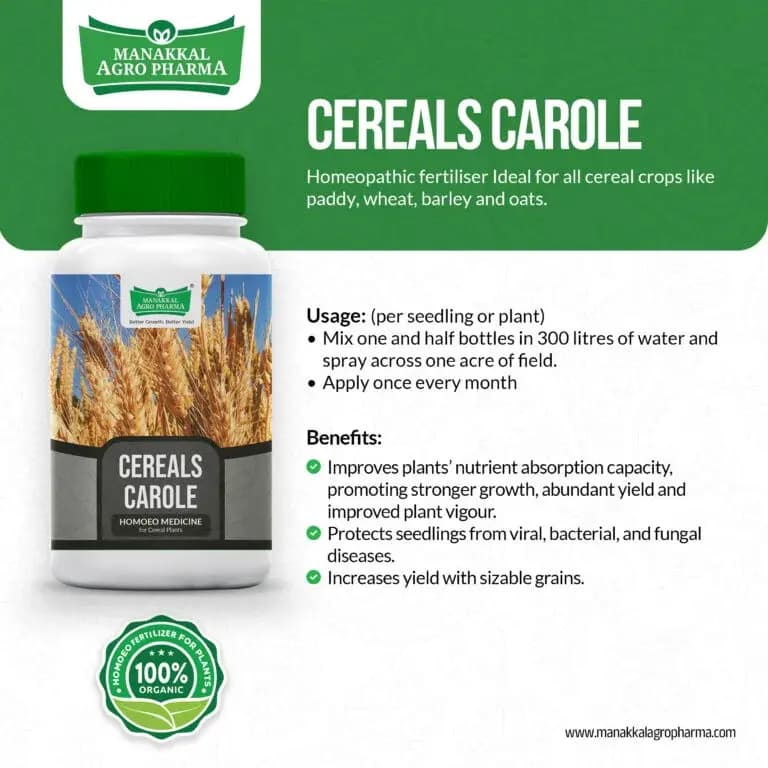
Cereals Carole enhances crop vigour, supports disease resistance, and promotes sustainable cereal production.
This study reports field evidence from two rice-growing regions of central Kerala on the efficacy of the agrohomoeopathic formulation Cereals Carole in enhancing crop vigour, minimising disease pressure and reducing the dependency on chemical fertilisers. Drawing on case-based field observations from Thrissur and Kottayam, the study examines physiological responses, health indicators and yield outcomes following the application of the remedy. The results indicate improved vegetative growth, lower incidence of major diseases, enhanced soil health, reduced production cost and increased eco-sustainability. The findings support the hypothesis that agrohomoeopathic preparations, applied at ultra-low doses, stimulate plant physiological pathways, enzymatic activation and immunity, generating measurable agronomic benefits.
Introduction
Rice (Oryza sativa L.) forms the foundational food crop of Kerala, yet productivity is persistently challenged by biotic stresses such as bacterial leaf blight, sheath blight, leaf spot, blast, tungro viral disease, stem borer, root borer, leaf folder and various hopper infestations. Conventional fertilisers and pesticides remain the dominant control measures, but they are associated with high cost, diminishing soil quality, environmental toxicity and farmer health risks.
Agrohomoeopathy—an emerging branch of ecological agriculture—proposes that ultra-diluted plant-derived or mineral preparations can modulate plant physiological responses, strengthen immunity and enhance resilience against pests and diseases. The present study documents two Kerala farmers’ long-term field observations after applying Cereals Carole, a homoeopathic rice remedy, in their paddy fields.
Study Objectives
To document field-level physiological and agronomic responses to the application of Cereals Carole in rice cultivation.
To evaluate effectiveness of Cereals Carole in managing common rice diseases and pests.
To assess Cereals Carole’s role in reducing fertiliser requirements and production costs.
To study the physiological and biochemical mechanisms underlying the observed improvements.
Hypothesis
The study hypothesises that the agrohomoeopathic formulation Cereals Carole, when applied at recommended dilutions, enhances plant physiological vigour, improves enzymatic activity, strengthens innate immunity and reduces susceptibility to major rice diseases. It is further hypothesised that these effects will lead to increased field uniformity, reduced fertiliser dependence, and improved overall yield, even in fields of moderate fertility.
Study Methodology
This is a qualitative, case-based observational study using field narratives from two farmers:
Vineeth Cheruthuruthi (Thrissur) – 12 years in farming and a practising lawyer, cultivating approximately one acre of rice.
Titto Maliyekkal (Kaduthuruthi, Kottayam) – experienced rice farmer familiar with conventional and organic inputs.
Both farmers applied Cereals Carole either as a root-zone drench (Thrissur) or foliar spray (Kottayam) and observations were documented appropriately.
Case Observations
Case 1: Vineeth Cheruthuruthi, Thrissur
Vineeth applied 1.5 bottles of Cereals Carole diluted in 200 litres of water over one acre of rice. The first application occurred early in the vegetative stage, followed by a second application on the 60th day of planting. Five days after the initial application, the rice plants exhibited pronounced vigour, shifting from medium-grade growth to a robust, uniformly green stand. The entire field displayed dense coverage of healthy rice tillers (tillering shoots), indicating early activation of vegetative metabolism.
The farmer reported that the remedy effectively eliminated the need for a second round of fertiliser application, reducing cultivation costs by nearly fifty percent. The plants demonstrated improved chlorophyll density, tiller multiplication and resistance to early leaf diseases. Vineeth emphasised that the remedy was eco-friendly, safe for field workers and beneficial soil organisms and did not compromise soil health.
Case 2: Titto Maliyekkal, Kottayam
Titto employed Cereals Carole primarily as a foliar spray. He noted that the quantity required was only one-fifth of what is typically used when applying conventional chemical fertilisers. The ease of application, absence of toxicity and low cost were important advantages. After treatment, the crop showed increased immunity, reduced infection pressure from major fungal and bacterial diseases and improved physiological vibrancy. According to the farmer, the plants exhibited enhanced leaf sheen, broader lamina, and improved resistance against hopper burn and leaf folder damage.
Disease Context in Kerala Rice Cultivation
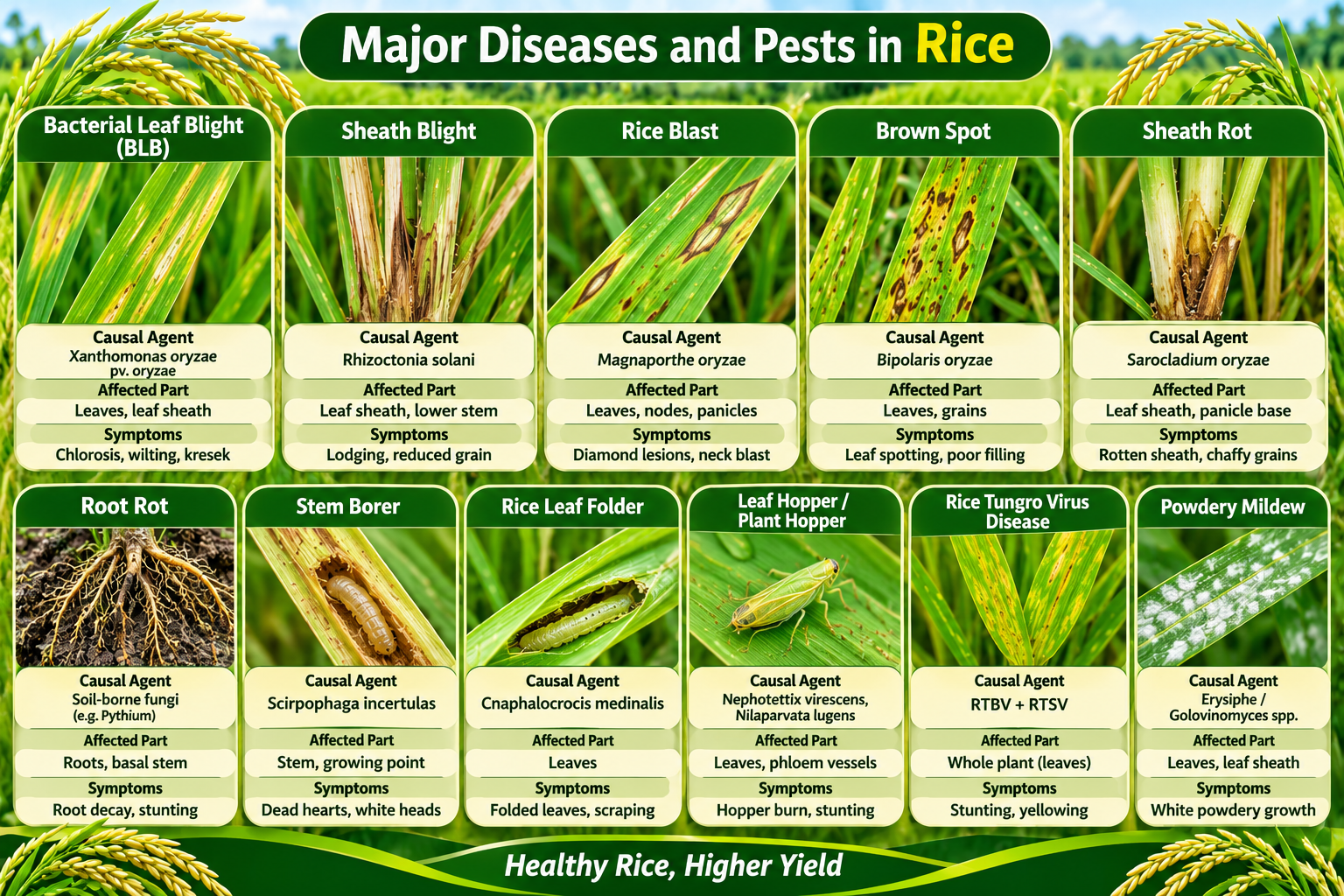
The agroecosystem in Kerala commonly experiences the following rice diseases and pest attacks:
Disease / Pest | Causal Agent | Affected Plant Part(s) | Outcome / Symptoms |
Bacterial Leaf Blight (BLB) | Xanthomonas oryzae pv. oryzae | Leaves, leaf sheath | Severe chlorosis, wilting, leaf drying, kresek symptoms, yield loss |
Sheath Blight | Rhizoctonia solani | Leaf sheath, lower stem | Lodging, reduced grain formation, rapid spread in humid fields |
Rice Blast | Magnaporthe oryzae | Leaves, nodes, panicles | Diamond-shaped necrotic lesions, neck blast, panicle sterility |
Brown Spot | Bipolaris oryzae | Leaves, grains | Leaf spotting, reduced photosynthesis, poor grain filling |
Sheath Rot | Sarocladium oryzae | Leaf sheath, panicle base | Rotten sheath, chaffy grains, panicle emergence failure |
Root Rot | Soil-borne fungi (e.g., Pythium, Rhizoctonia) | Roots, basal stem | Root decay, stunting, yellowing, reduced nutrient uptake |
Stem Borer | Scirpophaga incertulas (Yellow stem borer) | Stem, growing point | “Dead hearts” in vegetative stage, “white heads” in maturity stage |
Rice Leaf Folder | Cnaphalocrocis medinalis | Leaves | Folded leaves, scraping damage, reduced photosynthetic area |
Leaf Hopper / Plant Hopper | Nephotettix virescens, Nilaparvata lugens | Leaves, phloem vessels | Hopper burn, stunting, viral disease transmission |
Rice Tungro Virus Disease | Rice tungro bacilliform + spherical viruses (RTBV + RTSV) | Whole plant, especially leaves | Stunting, orange-yellow discolouration, poor tillering, major yield reduction |
Powdery Mildew | Erysiphe or Golovinomyces spp. | Leaves, leaf sheath | White powdery growth, weakening of foliage, reduced vigour |
Both case fields noted significantly reduced severity of these threats after homoeopathic intervention.
Results
Across both case studies, the application of Cereals Carole produced several consistent outcomes:
Rapid enhancement of vegetative vigour within days.
Increased number and health of tillers, reflecting activated growth physiology.
Improved chlorophyll density and leaf pigmentation.
Lower incidence of fungal and bacterial diseases.
Elevated immunity and recovery from initial stress symptoms.
Reduction in fertiliser requirements and overall cost of cultivation.
No adverse effects on soil, water or beneficial organisms.
Increased uniformity of stand and improved field appearance.
In Vineeth’s case, the remedy replaced the second fertiliser cycle entirely, while Titto noted that the required quantity was only a fraction of chemical input norms.
Discussion
The observed results support the hypothesis that agrohomoeopathic organic remedy Cereals Carole acts by stimulating the plant’s internal regulatory systems rather than by supplying nutrients externally.
Physiological Activation
The enhanced vigour, greener foliage and multiplied tillers suggest activation of plant-growth enzymes such as nitrate reductase, dehydrogenases and chlorophyll-synthesis pathways.
Immune Modulation: Reduced disease incidence aligns with stimulation of systemic acquired resistance (SAR)
Improved Nutrient Utilisation: Plants showed efficient nutrient uptake even without additional fertiliser. This indicates increased root absorption capacity and possibly enhanced root-hair proliferation.
Soil Health and Sustainability: The remedy’s non-toxic nature promotes soil microbial networks, improving organic matter cycling, mineral availability and long-term fertility.
These interpretations align with the growing body of literature on bio-stimulants and homeopathic plant remedies, suggesting that small-dose stimuli can trigger self-organising physiological responses in plants.
Conclusion
The field evidence from Thrissur and Kottayam collectively demonstrates that Cereals Carole is associated with significant improvements in rice crop performance, disease resistance, and economic feasibility. It reduces the dependence on chemical inputs, enhances plant vitality, and supports sustainable cultivation practices. Further controlled experiments, including replicated field trials and biochemical assays, are recommended to validate the mechanisms in detail.
Buy now : https://manakkalagropharma.com/product/cereals-carole